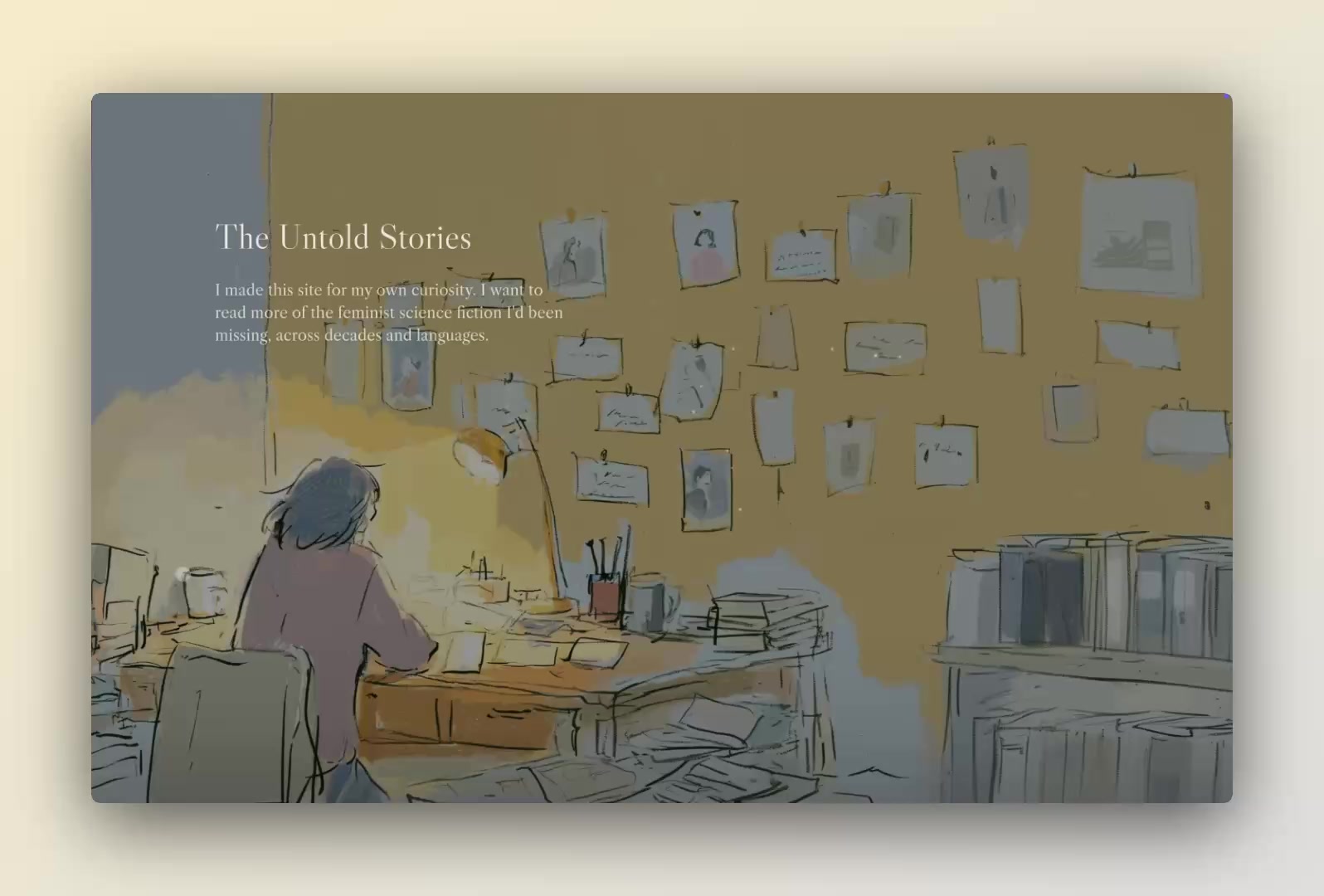
Women in Science Fiction — cover
Self-Directed Research

Women in Science Fiction

A web experience tracing women's sci-fi across the globe, and what never reached English.

2026 Ongoing
6 min

Overview

This is a research-driven interactive web experience that traces the story of women sci-fi writers across decades and languages. It consists of personal essays and archive materials that unfold the system behind a piece of women-produced sci-fi: how it gets translated, classified, published and awarded. More importantly, what this system leaves out. Sci-fi by women has long been underrepresented and miscategorized in this male-dominated field; and once you factor intersectionality, the voice from women of color rarely reaches the Anglophone readers.

It is an ongoing project. So far: a 76-author dataset, 10 source-language reconnaissance memos, a cross-recon synthesis, a narrative spec, and a scroll-driven storybook site. They live in the open at Shellwecode/feminist-scifi.

Why I started

I made it for my own curiosity. I wanted to read more of the feminist science fiction I’d been missing and to understand why I’d been missing it. I was eight when I first read 张晓风 (Zhang Xiaofeng), at the time filed as an essayist but whose early work is now recognized as the first piece of Chinese-language science fiction. Then, in college, I saw translation decide, in real time, which work got to travel beyond its source language and which didn’t.

Riso print in blue and gold: a girl alone at a desk, reading an oversized book among shelves

I am curious about

1. How much of the women’s sci-fi has gone absent, untranslated, or filed under a different label?
2. Who draws the genre line, and who gets filed by it?
3. What role does translation play in communicating and preserving the story?
4. What does the map of absence look like?

Bias in the dataset

Phase 1: Individual authors

Phase 1 was per-author research files across 7 regions. I researched 76 authors total, weighted toward Anglophone (29) but spanning East Asian, African + diaspora, Latin American, European non-English, South Asian, and MENA writers. I capped the Anglophone canon, and studied how the works influence each other. In , I also explicitly documented the exclusion in the literary world: pre-2000 Brazilian women’s SF, the ninety-year South Asian gap, Korean SF before 1992 — and the “women writers” framing’s exclusion of non-binary writers, flagged as a judgment call still open for revisiting, not settled.

gaps.md 107 lines view on GitHub ↗

Gaps Inventory — Phase 1 → Phase 2

This file is an honest record of what is missing, under-represented, or weakly sourced in the dataset. It is an input to phase 2 (data normalisation) and phase 3 (visualisation design), not a bug list to be silently closed.

Regional gaps

Pre-2000 Brazilian women’s SF

Finisia Fideli is one entry intended to represent a whole pre-2000 Brazilian women’s SF tradition that is badly under-documented in English. Names that belong in a fuller dataset:

  • Sonia Sant’Anna
  • Giulia Moon
  • Dinah Silveira de Queiroz (1911–1982) — earlier generation, debatable SF but influential
  • Ana Rüsche (more contemporary)
  • Rosana Rios

Sourcing for these requires Portuguese-language scholarship (Roberto de Sousa Causo’s histories are the primary reference). Phase-2 should budget specifically for Portuguese-language source review.

MENA pre-2010 women’s SF

Almost nothing. The included MENA authors (Abdel Aziz, Al-Maria, Sansour, Hareven) are all post-2010 publishers. Earlier Arabic-language women’s SF is effectively invisible to Anglophone sourcing. Candidates worth investigating in phase 2:

  • Salwa Bakr (Egypt) — speculative-inflected short fiction from the 1980s–90s.
  • Nora Naji (Morocco/France) — some speculative shorts.
  • Egyptian, Syrian, Lebanese SF writers of the 1970s–2000s: the tradition exists but is poorly accessible.

Chinese women’s novel-length SF

Short fiction is reasonably well-covered via Ken Liu’s translations (Clarkesworld, Invisible Planets, Broken Stars). Novels by Chinese women SF writers in English translation are extremely sparse; Hao Jingfang’s Vagabonds is one of very few. Chi Hui and Tang Fei have strong short-fiction careers but limited novel exposure. Phase-2 should check Storycom/Chinese-SFWA translation pipeline announcements for forthcoming novels.

Korean women’s SF pre-2000

Djuna (active since 1992) is our earliest Korean inclusion. Earlier Korean women’s SF — especially from the 1970s–1980s colonial/post-colonial period — is not documented in the dataset. Whether this reflects a real thinness of the tradition or an Anglophone-source blind spot is itself a phase-2 research question.

South Asian women’s SF between Hossain (1905) and Padmanabhan (1997)

A ninety-year gap. This is almost certainly a sourcing blind spot rather than an absence of writers. Bengali, Marathi, Tamil, Urdu, Malayalam speculative fiction by women between WWI and the 1990s is a serious research gap. Relevant starting points for phase 2:

  • Sukanya Datta (Bengali SF)
  • Sumathi Mehta, Kamala Das (some speculative shorts)
  • Ismat Chughtai (mostly realist; occasional speculative moments)

Sri Lankan and Bangladeshi women’s SF

Bangladesh is represented only by Hossain (who wrote before partition). Contemporary Bangladeshi women’s SF is unrepresented. Sri Lankan women’s SF is entirely absent from the dataset.

Indigenous women’s SF

Only Rebecca Roanhorse appears. Cherie Dimaline (The Marrow Thieves), Waubgeshig Rice (male; different author), Louise Erdrich (largely literary but with speculative threads — Future Home of the Living God), Darcie Little Badger, Daniel H. Wilson (male), Marie Battiste — a broader roster suggests a plausible Indigenous-Americas regional bucket in phase 2 rather than the current “other” placement.

Non-binary / genderqueer SFF writers

The brief framed the dataset around “women science fiction writers.” That framing necessarily excludes Akwaeke Emezi, Rivers Solomon, and other non-binary writers in the Afrofuturist tradition, Neon Yang, JY Yang (when they wrote as JY), and others whose work is vital to the feminist-SF conversation but whose authors are not women. Karin Tidbeck uses they/them and is included here with a note; their inclusion vs exclusion is editorial judgment that phase 2 should revisit.

Authors likely important but thinly documented in English

  • Chi Hui (Chinese): novel-length translations missing.
  • Kurahashi Yumiko (Japanese): A Round Trip to the Land of Amanon not in English.
  • Ōhara Mariko: only one novel in English (Hybrid Child, 2018); short fiction scattered.
  • Teresa P. Mira de Echeverría (Argentina): anthology-only availability.
  • Maria Galina (Russia): considered and cut for space; important voice of 2000s Russian fantastic literature.
  • Leena Krohn (Finland): cut for space; one of the central Finnish Weird predecessors.
  • Tashan Mehta (India): very recent breakout (Mad Sisters of Esi, 2023) cut for space.
  • Eugen Bacon (Tanzania/Australia): substantial body of work; cut for space.

Thematic gaps

Disability-centred SF as a theme

The vocabulary’s embodiment conflates disability-led SF with broader body-politics SF. Kim Choyeop (hearing loss, explicit), Nicola Griffith (MS, explicit), Vonda McIntyre (medical fiction), and Butler (chronic illness threads in Parable of the Sower) deserve a distinct disability tag.

Translation-as-politics as a theme

Le Guin’s Lao Tzu and Gorodischer translations, Leckie’s pronoun politics, Wittig’s grammatical insurrection, Tidbeck’s Amatka, Xia Jia’s cross-cultural essayism — there is a tradition of translation-as-political-act running through feminist SF that the current vocabulary tags only tangentially (via language).

Afrofuturism / Africanfuturism / Gulf Futurism as movement-political identification

The colonialism and race tags do not capture the self-organised movement-political dimension. Phase-2 should consider whether to add movement-politics as a distinct tag or whether the geographic metadata can carry that information.

Translation-metadata gaps

Translation history is the single weakest data class in the dataset. The per-author files give translator names and years where known; for many authors (Tanith Lee, Chi Hui, Brazilian women, pre-2010 Russian) the translator attribution is partial, approximate, or simply unavailable in English sources. Phase 2 should consider:

  1. Scraping ISFDB.org systematically for translation-edition records.
  2. Consulting WorldCat for holdings-level translation evidence.
  3. Reaching out to translator organisations (PEN Translates, ALTA) for clearer attribution chains.
  4. Distinguishing “confirmed translator + year” from “translation exists, translator unknown” as two distinct data states.

Influence-edge coverage

Applied a strict sourcing rule: influence edges require a documented statement (interview, letter, scholarly citation, acknowledgement). This produces honest edges but almost certainly under-counts real influences. In particular:

  • Peer influences within cohorts (e.g., Japanese New Wave writers in the 1970s influenced each other; direct statements per pair are missing).
  • Influences mediated through translation (e.g., which Anglo-American women SF writers shaped the 1990s Korean SF formation: Djuna and Kim Bo-Young’s Le Guin citations are recorded; the broader reading environment is not).
  • Women-to-women chains that go undocumented because interviewers don’t ask: Tanith Lee’s influence on later British SFF, for instance, is patchily recorded.

Phase 2 should distinguish between documented edges (safe for visualisation) and a separate plausible-edges file that flags likely influences without asserting them.

Metadata-format issues for phase 2

  • Some authors span multiple regions: Suzuki Izumi (Japan), Hopkinson (Jamaica/Canada/US), Chaviano (Cuba/US), Ōhara (Tokyo but globally read), Serpell (Zambia/US). Region is currently single-valued; phase 2 may need a primary + secondary region field.
  • Non-prose authors: Kahiu, Al-Maria, Sansour are film/visual primary. A primary_medium field separate from form may help.
  • Gender: the dataset is framed around women. Tidbeck (they/them) is included with a note. A pronouns or gender field would make this explicit rather than implicit.

What the dataset is good at

To balance the gap record: the Anglophone and East Asian regions are richly sourced with credible translation-edition records and multiple verifiable influence edges. The influence graph through Butler, Le Guin, Russ, Tiptree, and Okorafor is dense and well-sourced. Most entries have at least one direct URL and one cited scholarly or editorial source. The “influence edges as documented statements only” rule yields a graph that is smaller than the reality but safe to visualise.

Riso print of overlapping silhouettes of women writers, layered blue on cream

Phase 2: Source-language reconnaissance

Since phase 1 was built on English-language sources, I ran a second research pass with an inverted methodology from phase 1: source-language venues first, English only as supported confirmation. I was surprised that around 30% of the English-language results from phase 1 were inaccurate. For instance, Nora Naji is actually an Egyptian novelist but not Maghrebi; Sonia Sant’Anna writes historical novels but not sci-fi. The claim that Chinese women’s novel-length SF is “sparse” is empirically wrong in Chinese.

The gap here is in the translation pipeline.

More importantly, the translation gap is not equivalent to writing gap. Six regions have rich source-language traditions that simply never reached English. Treating “scarce in English” as “scarce” had been distorting the whole dataset.
Riso print of two facing pages whose text dissolves into a cloud of blue ink

The recurring form of absence

I thought the source-language approach would have cleared up most of the inaccuracies, but it only corrected the surface. More structural bias appears:

1. The foundational women are filed elsewhere.

In 8 of 10 regions, the woman closest to a tradition’s founding was catalogued as “literary,” “essayist,” or “poet”, and missed by genre history entirely. This includes Karin Boye, Dinah Silveira de Queiroz, 張曉風, Magdalena Mouján Otaño, Buchi Emecheta.

2. Gendered genre-policing.

On 晋江, women’s speculative writing at massive scale is filed as 言情/仙侠/玄幻, but almost never 科幻. They are excluded from the SF canon by definition alone. Prestige publishing does it too: Bazterrica’s Cadáver Exquisito is ciencia ficción in Argentina, “horror” in the US.

3. Prize asymmetry.

Germany’s Kurd Laßwitz best-novel award: one woman laureate in 45 years. Recognition skews harder against women than publication does and a prize rarely comes with a translation budget.

Riso print of rows of folder tabs and filing drawers, blue on cream

A more honest narrative

The data naturally revealed a more honest narrative, and I connected them together.

Feminist sci-fi is not yet a global conversation but a scattered set of solitary efforts. The translation lag is closing, but it largely depends on the named translators’ decisions. Behind the scenes, the story of feminist sci-fi is also a story about the field builders, editors, prize-founders, translators.
Riso print of a map whose regions dissolve into dotted gaps and missing coastlines

Building the site

Three build iterations, each a full working site: a “narrative museum” that proved the structure, storybook vignettes where vertical scroll drives horizontal page-turns, and a hand-drawn illustrated study as the opening — all vanilla HTML/CSS/JS, fully keyboard-navigable, with prefers-reduced-motion fallbacks throughout.

Phase 1 of the site — the illustrated study, postcard hotspots, and the scroll into the first vignette.

What I learned

  1. The bias is in the sources, not just the canon. Building from English-language references reproduces the exact exclusions the project set out to document. The 30–40% error rate on inherited names is the strongest argument I have for source-language-first methodology — and it only became visible because Phase 1’s assumptions were written down explicitly enough to falsify.
  2. Record what you reject. The “considered and rejected” lists and gaps.md turned out to be the most intellectually valuable files in the repo. The dataset’s edges — who’s excluded, and by what rule — carry as much of the argument as its contents.
  3. Let the data revise the thesis. The romantic version didn’t survive contact with the evidence. The honest version — scattered solitaries, an Anglo-American crystallization, a conditional and fragile translation surge — is a better story because it’s true.
  4. Absence needs typology. “Missing” is four different phenomena with four different implications. Designing empty rooms with labels was more honest — and more affecting — than filling them with weak evidence.
  5. In design, the quiet solution usually wins. Nearly every visual iteration moved from more (washes, outlines, glows, big titles) to less (existing tones deepened, a hairline border, a smaller title in the corner).

What’s next

  • Phase-2 dataset expansion: ~115 source-language-verified Tier-1 candidates across ten regions — a 2–3× expansion, with the new data fields the recons demanded.
  • Revisit the framing exclusion: extend non-binary inclusion to the seven flagged writers whose work is central to the feminist-SF conversation.
  • Finish the rooms: replace placeholder illustrations in the vignettes and closing cases; build out the field-builders room.
  • Verify the load-bearing edge: 钱莉芳’s 《天意》 (2004) → Liu Cixin’s 《三体》 — if the verbatim source confirms, a woman’s novel is the acknowledged precedent for the most famous work in Chinese SF.
Women in Science Fiction 8 sections
0:00 / 6:15